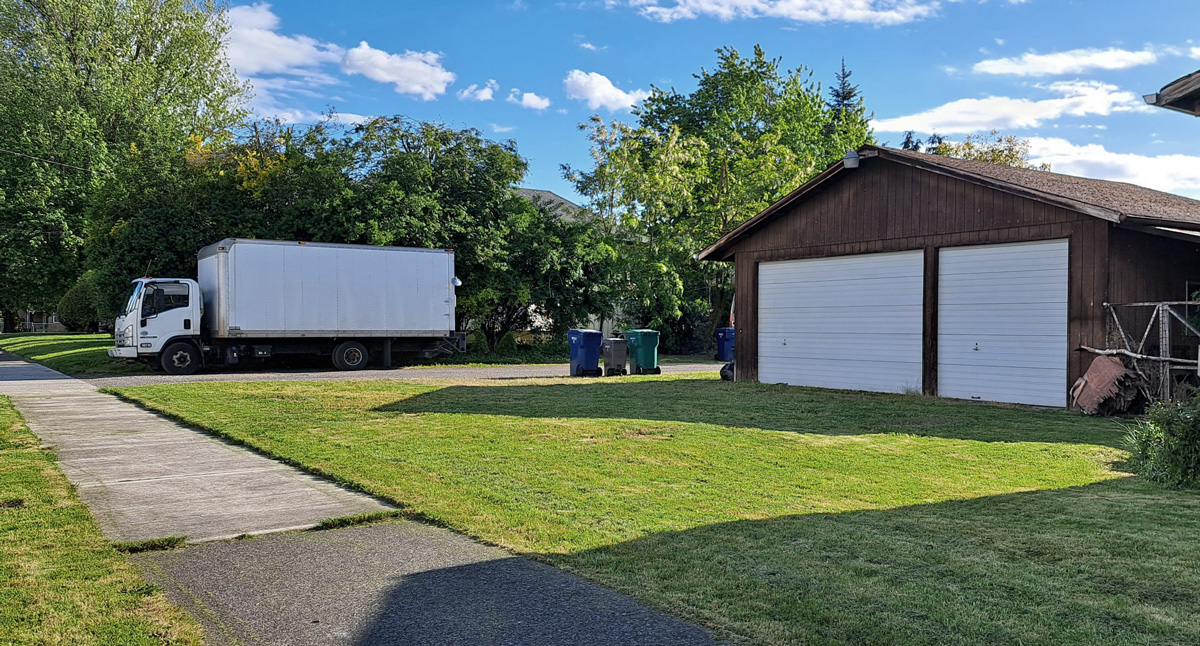
This is a land and infrastructure play on Auburn's SR-167 freight corridor, one of the Pacific Northwest's primary industrial arterials. The 0.20-acre parcel carries Commercial / Light Industrial zoning, three-sided vehicle access including confirmed semi-truck-capable capacity, a high-clearance two-bay garage operational today, and a small loading dock. Annual taxes of $3,160 on a $550,000 ask reflect a King County assessment of $250,200, the gap between assessed and ask represents real upside for a buyer who understands this corridor. Comparable C/LI zoned parcels with equivalent SR-167 corridor access in Renton trade at a significant premium. Auburn's completed Environmental Impact Statement eliminates additional SEPA review, and city development fees have been frozen since 2009. The building is an additional asset, offered as-is.
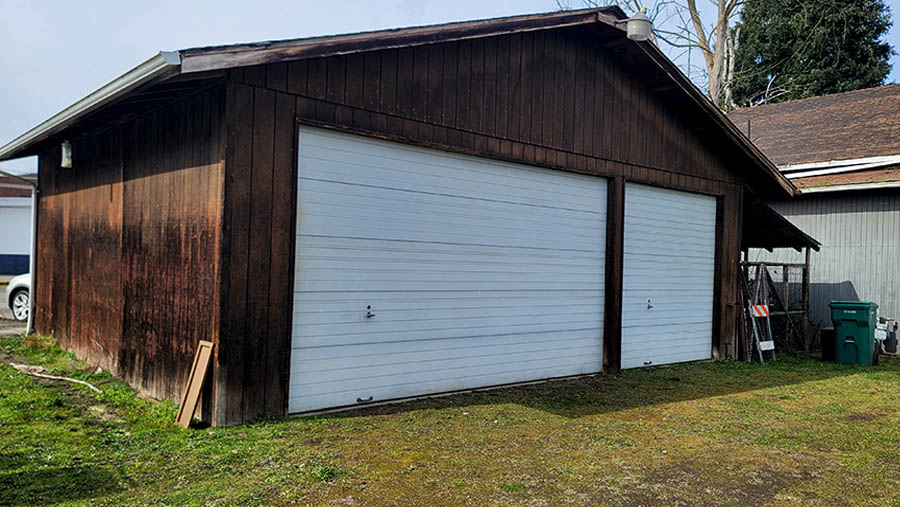
Historically used to store a boat, full-size truck, and multiple snowmobiles simultaneously. Ceiling height well exceeds standard residential clearance. Operational today without improvement.
| Parcel Number | 192105-9237 |
| Legal Description | Auburn W 65 ft of E 130 ft of N 134 ft of NW¼ of SE¼ Less St |
| Lot Size | 8,710 SF / 0.20 Acres |
| Dimensions | 134 ft × 65 ft |
| Zoning | Commercial / Light Industrial / Residential |
| Structure | Wood frame, post and pier foundation |
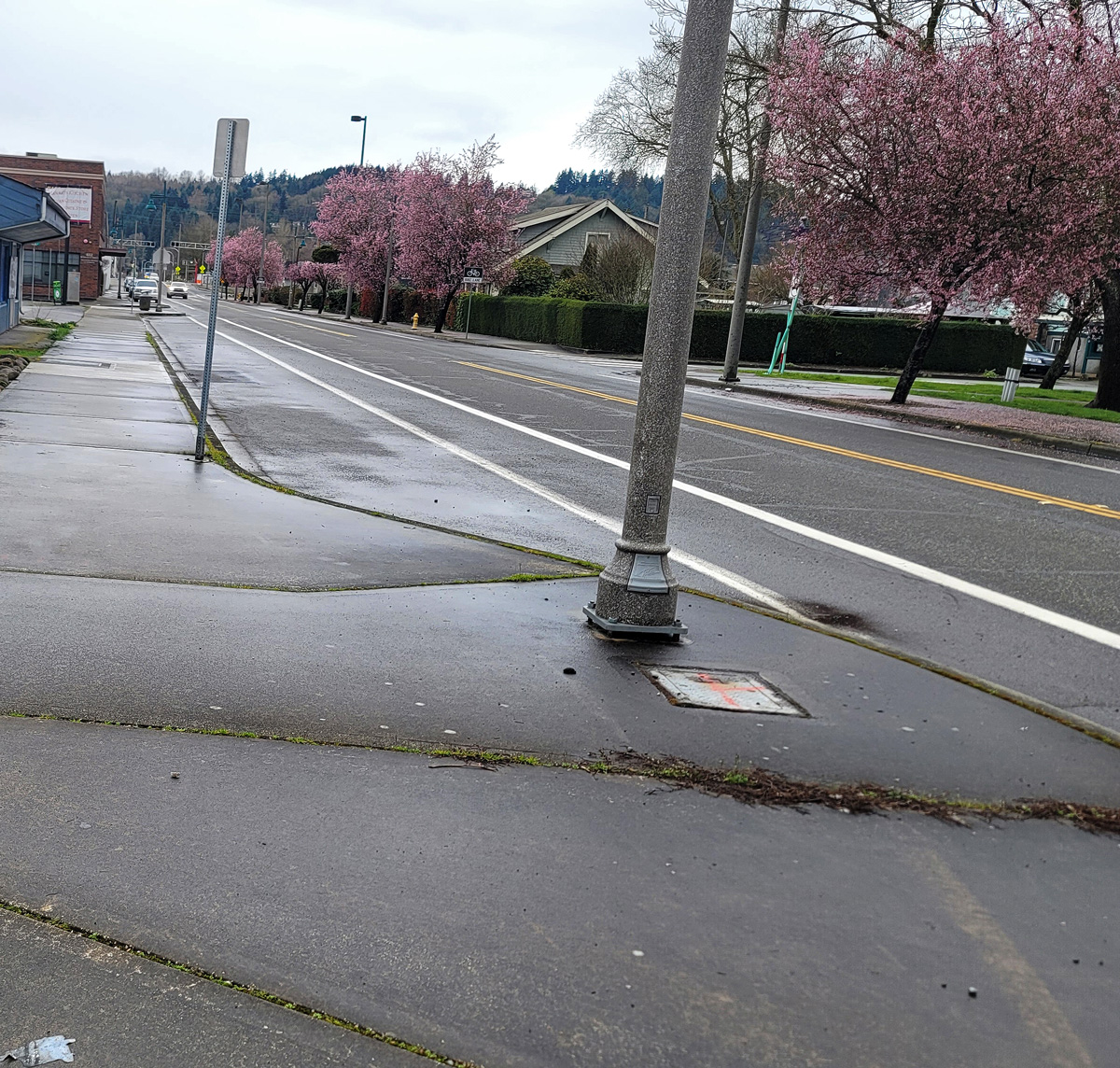
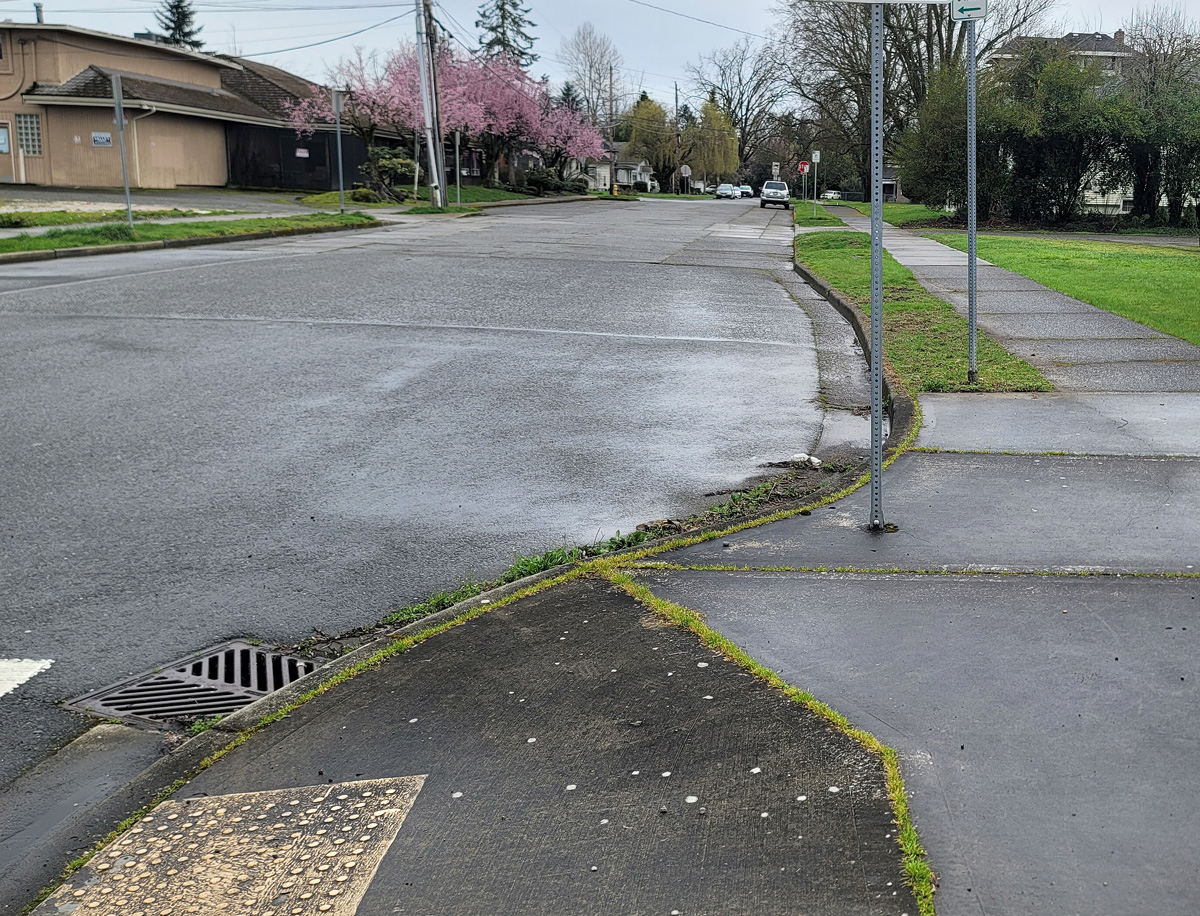
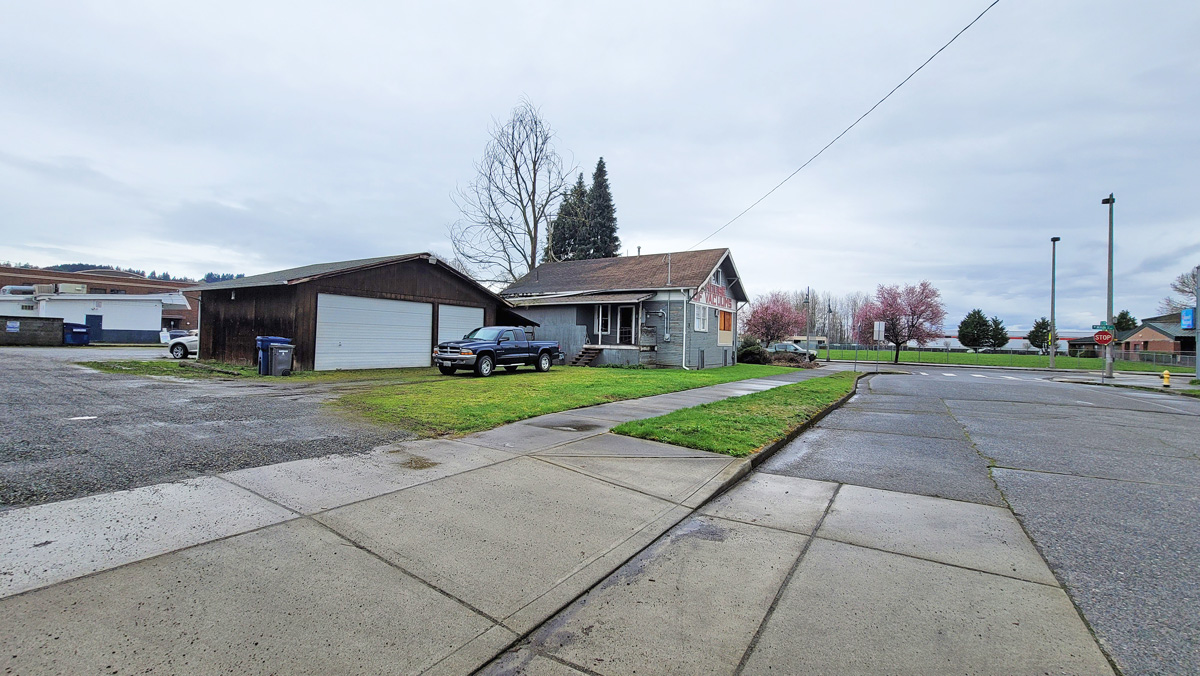
| Parking | Three sides, West Main Street frontage, side street, rear lot |
| Commercial Vehicle Access | Semi-truck-capable parking confirmed, side lot in active informal use |
| Loading | Small loading dock at rear of main building |
| Annual Tax (2024) | $3,160 |
| Current Assessment | $250,200 |
| Terms | Cash or Conventional · Building offered as-is |
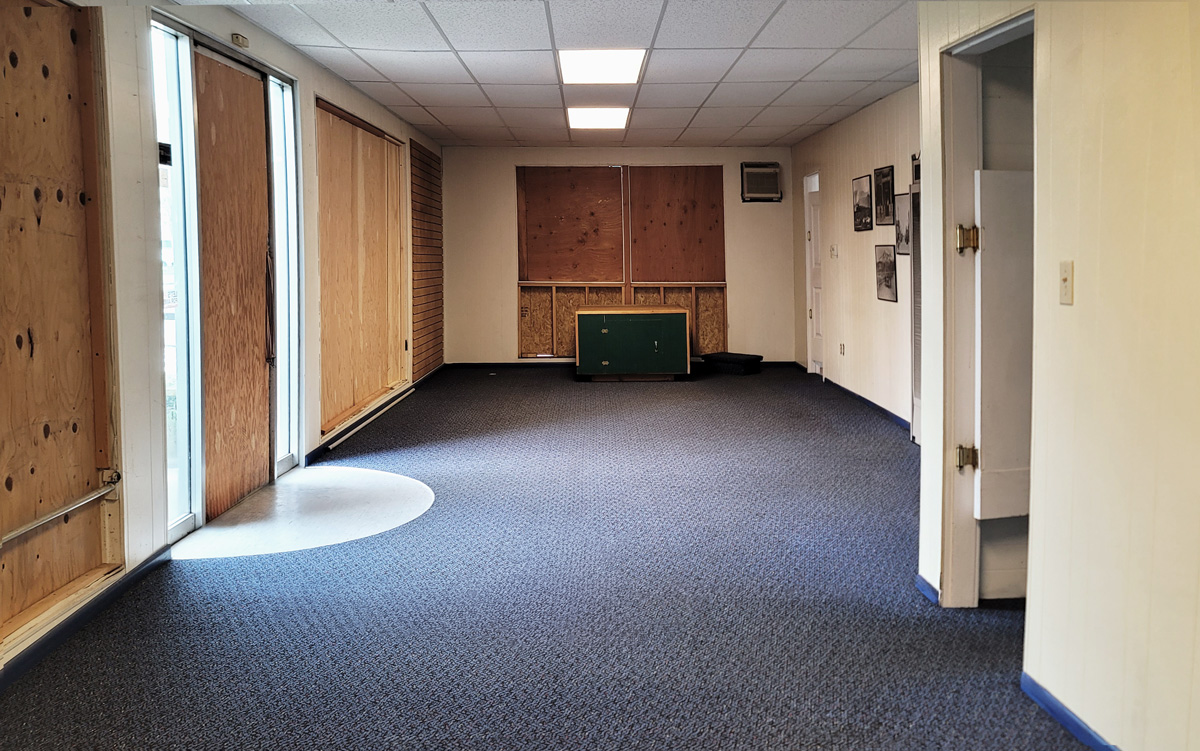
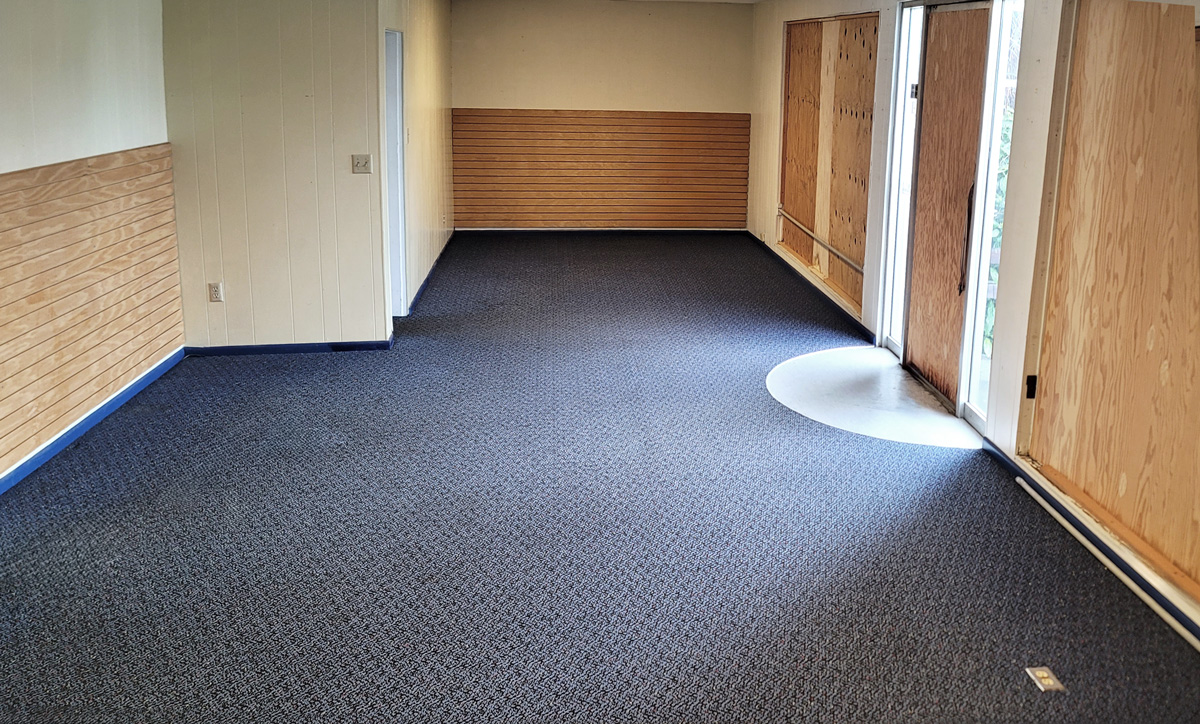
Ground Floor, Commercial
| Use | Retail / light industrial / office |
| Ceiling | Drop ceiling installed; original high wood plank ceiling intact above, undisturbed since original construction |
| Flooring | Original fir floors beneath current surface |
| Entry | West Main Street frontage |
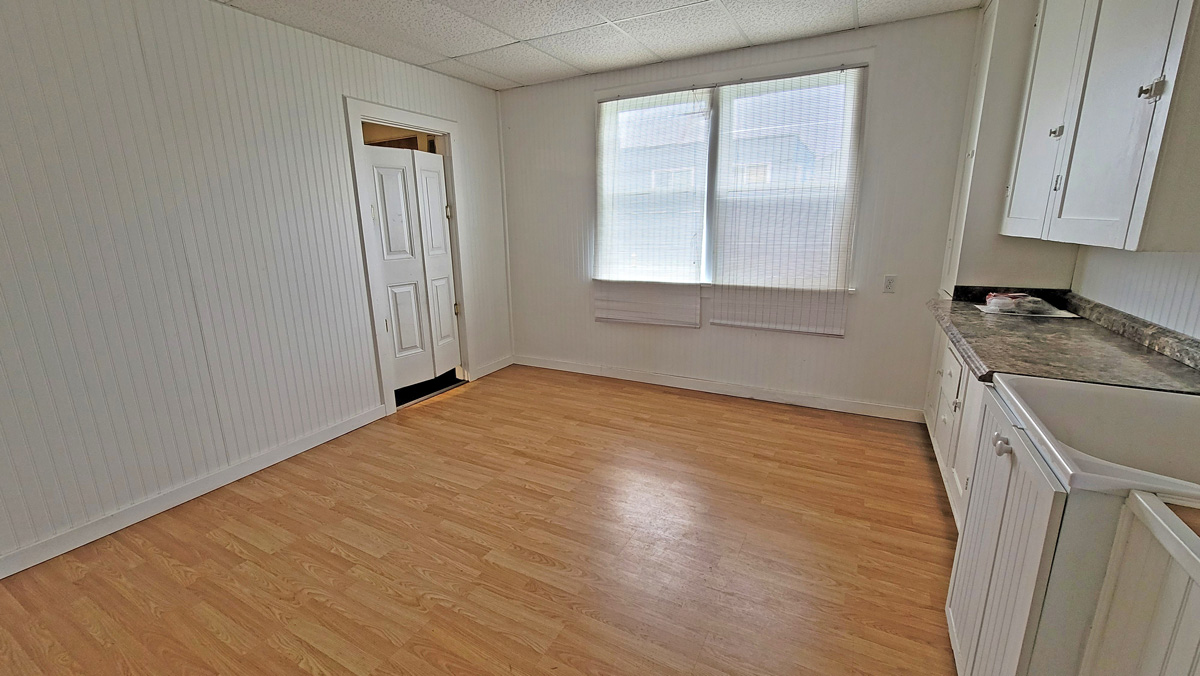
Upper Floor, Apartment
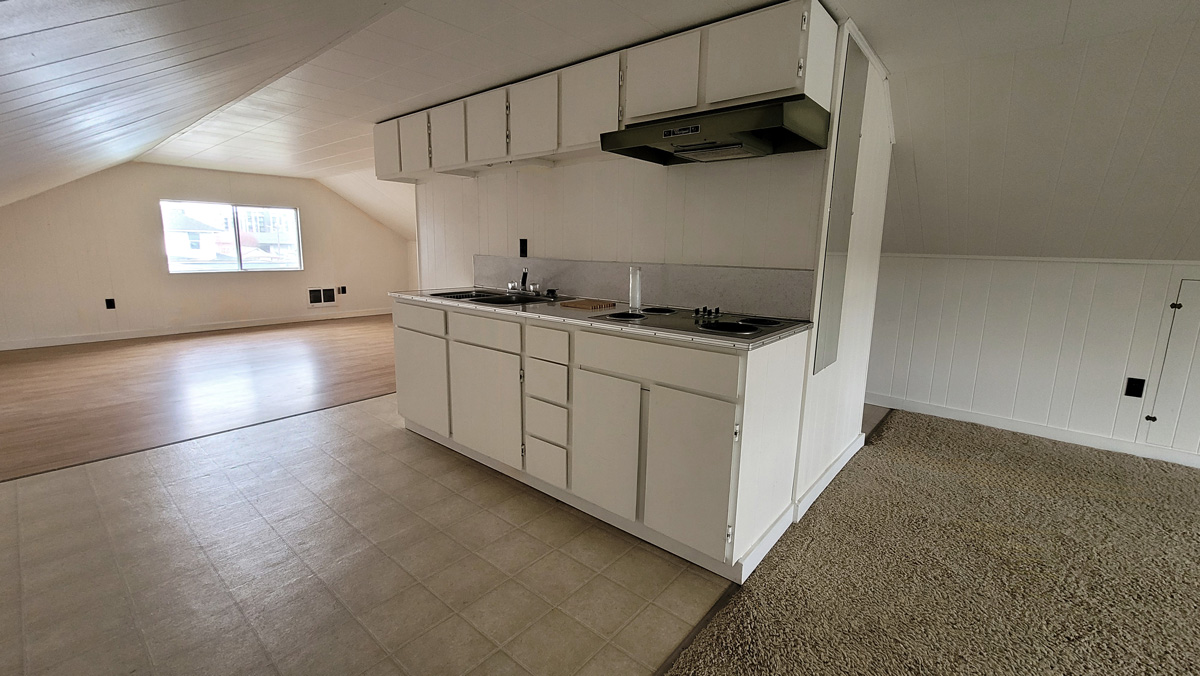
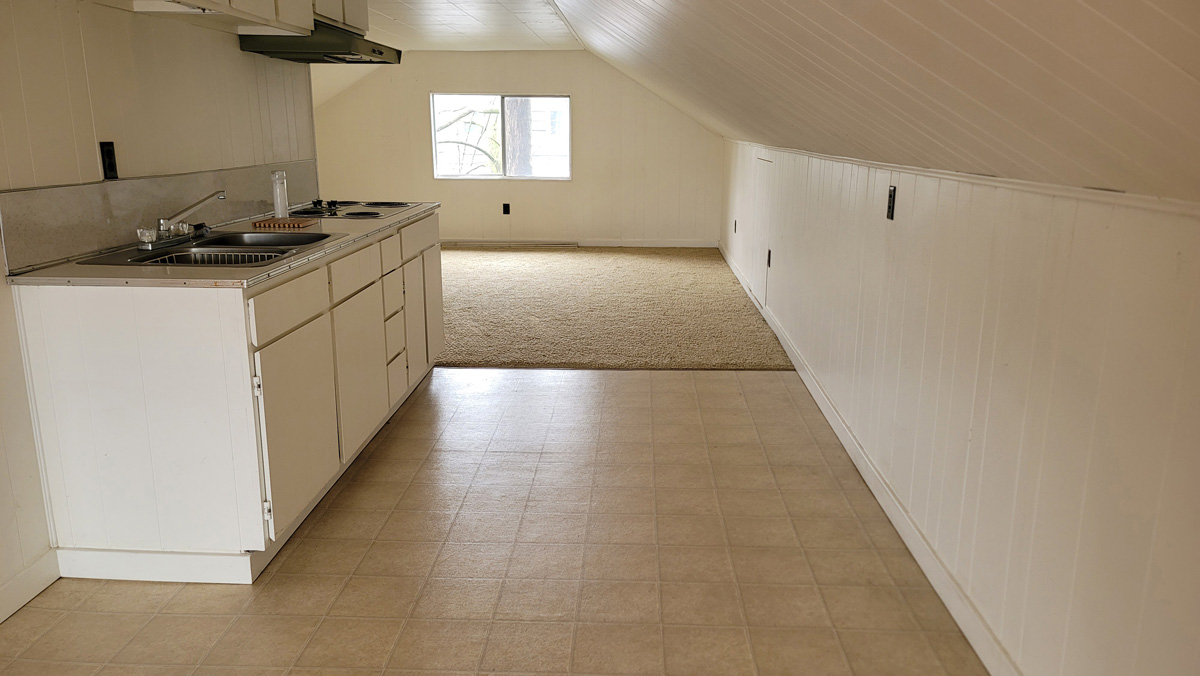
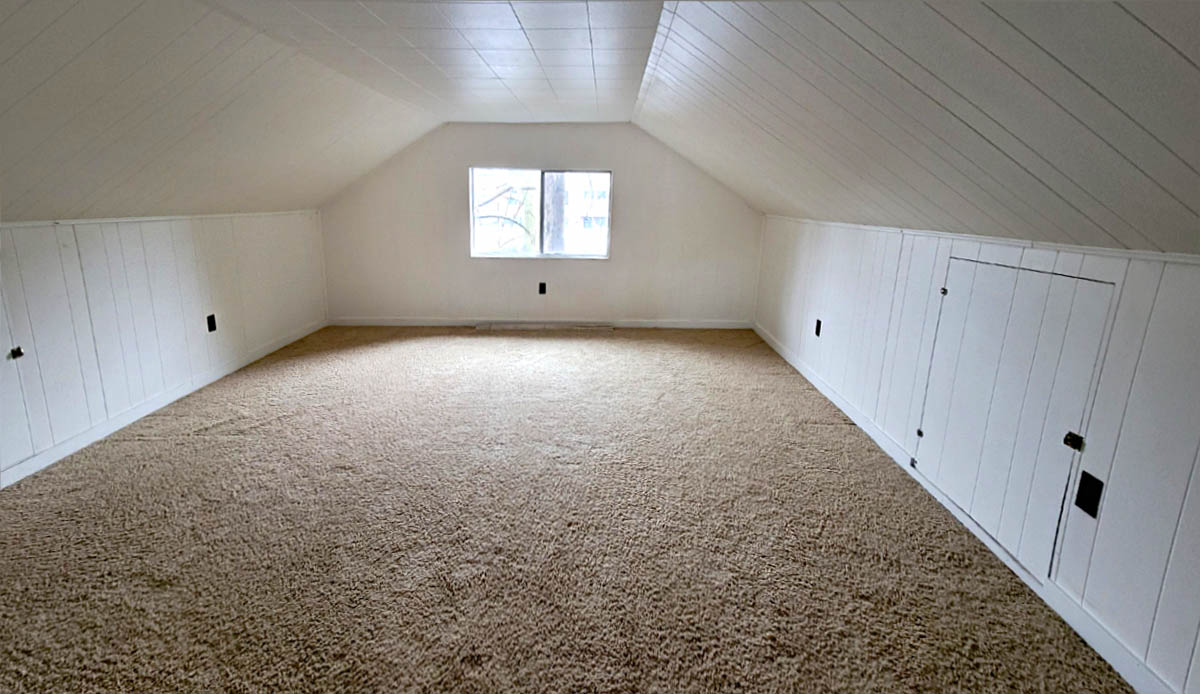
| Layout | Kitchen, living area, bedroom, closet |
| Bathroom | Located on ground floor |
| Water | Not currently connected; infrastructure present |
| Potential | Live/work, rental income, owner-operator |
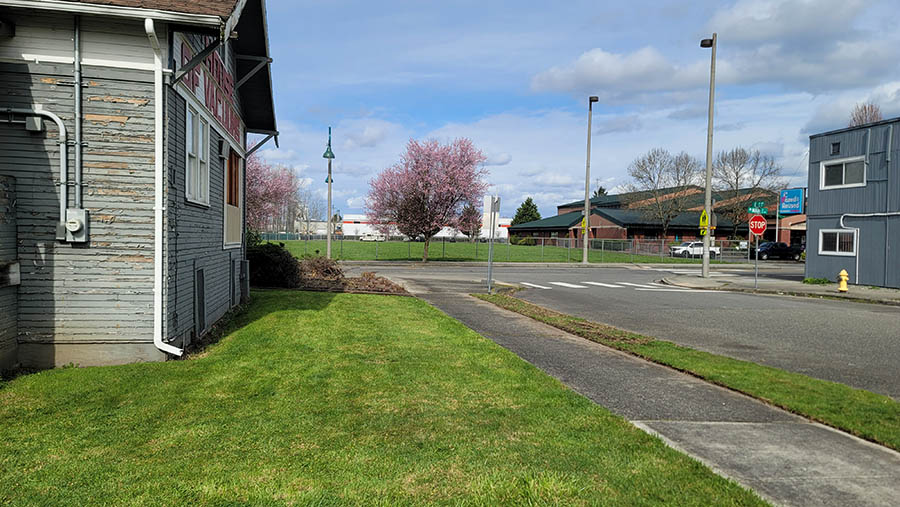
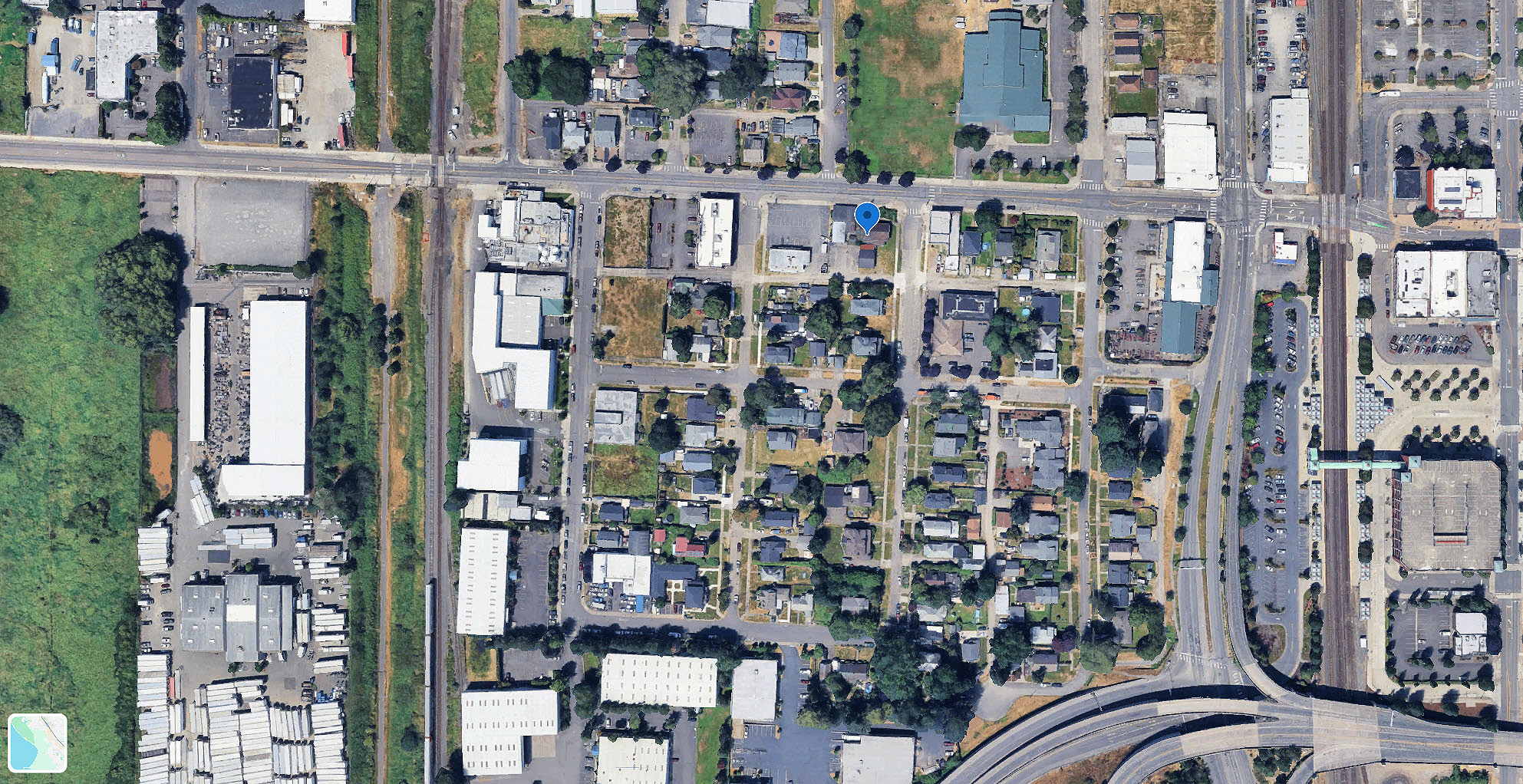
Upper apartment · Vaulted ceiling · Built-in storageLocated one block from SR-167, Auburn's primary freight arterial serving the Green River Valley industrial corridor, the densest concentration of warehouse and distribution infrastructure in the Pacific Northwest. Amazon, IKEA, REI, Costco, UPS, and FedEx regional distribution operations all run this corridor. The property currently serves as an informal rest stop for commercial drivers. Auburn Municipal Airport is approximately two miles away, providing general aviation access with a 5,000-foot runway.
| SR-167 Access | ~1 block, primary Green River Valley freight arterial |
| Highway 18 | Direct via SR-167 interchange |
| I-5 | ~5 miles via SR-167 or Hwy 18 |
| Semi-truck-capable parking | Confirmed, side lot accommodates semi-trucks and dump trucks |
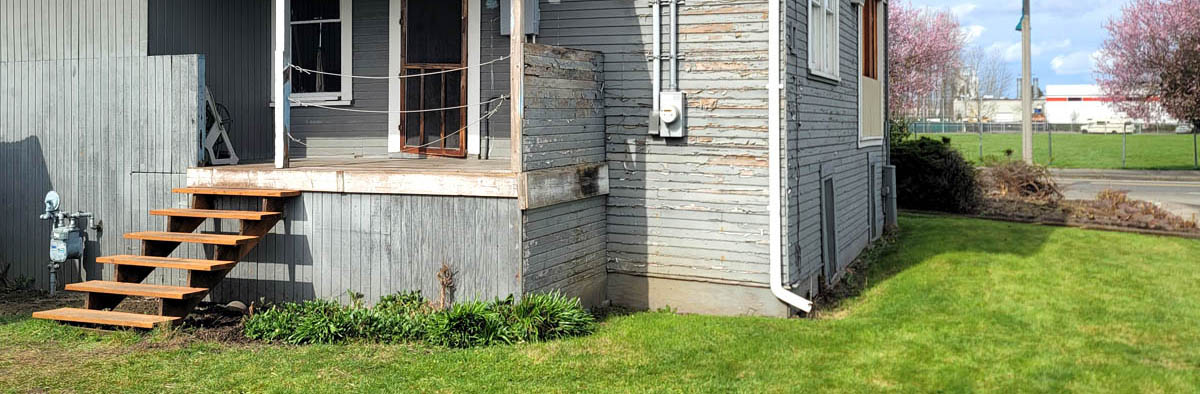
| Loading dock | Small dock at rear of main building, see photo below |
| Rail crossing bypass | Multiple routes bypass BNSF crossing and downtown congestion |
| Auburn Municipal Airport | ~2 miles · General aviation · 5,000 ft runway |
| Port of Tacoma | ~30 miles via I-5 South |
Rear of building · Small loading dockProperty offered strictly as-is. Seller makes no representations beyond the above. Buyers are advised to conduct independent inspection and due diligence prior to offer. Most redevelopment scenarios assume full or partial demolition of the main structure, with the detached garage retained as a separate operational asset.
Original fir floors and high wood plank ceilings remain intact above the existing drop ceiling, undisturbed since original construction. Original moldings and banisters are present throughout. These elements carry value for buyers pursuing adaptive reuse or historic rehabilitation tax credits.
Washington's Multifamily Housing Tax Exemption (MFTE) is a state-authorized program under RCW 84.14, administered locally by cities including Auburn. The 8-year exemption requires no affordable housing component, any market-rate multifamily project of four or more residential units may qualify. The 12-year exemption requires that at least 20% of units be affordable to low- and moderate-income households.
The exemption applies to the value of newly constructed residential improvements only, not the land, not retail portions, not existing structures. For mixed-use development, residential use must make up at least 50% of the space. Auburn requires audited expense records as part of its approval process.
Note: A 2021 legislative update (SB 5287) restricts the 8-year market-rate exemption in certain transit-dense areas. Given the proximity to Sounder rail, a buyer pursuing MFTE should verify eligibility with Auburn Community Development before acquisition.
MFTE eligibility is project-specific and subject to city approval. Verify current program terms directly with the City of Auburn Community Development Department prior to acquisition.
Regulatory context: The Puget Sound Regional Council designates Auburn's downtown as a Regional Urban Center, enabling higher density and land use intensity. The Auburn City Council has approved design standards for the Downtown Urban Center. The city's Comprehensive Downtown Parking Management Plan (2014) anticipated increased density, infrastructure built ahead of demand.
Auburn's immediate trade area generates sustained employment, retail traffic, and residential demand from several significant anchors, supporting the case for multifamily, mixed-use, light industrial, or commercial redevelopment.
This building's documented provenance positions it as a viable candidate for the National Register of Historic Places, unlocking one of the most powerful rehabilitation incentives in the federal tax code. The 20% Federal Historic Tax Credit applies directly to qualified rehabilitation expenditures and is in addition to any state or local preservation grants. For a buyer pursuing adaptive reuse, the credit represents a significant reduction in net rehabilitation cost.
| Federal Historic Tax Credit | 20% credit on qualified rehabilitation expenditures |
| Washington State Credit | Additional state-level credits may apply, verify with preservation consultant |
| Grant eligibility | State and local preservation grants available upon listing |
| Archival resource | White River Valley Museum, Auburn, holds relevant local historical materials |
| Physical evidence | 1942 grocery receipt, 1955 newspapers, antique bottles, tools, and historical photographs recovered from beneath the building |
Historic designation eligibility requires independent professional assessment. Engage a preservation architect or SHPO consultant prior to acquisition if pursuing this avenue.
The property is within walking distance of Auburn Sounder Station, providing direct daily rail service to Seattle (~33 minutes) and Tacoma (~20 minutes). The Interurban Trail, a fully paved multi-use regional path running the length of the Green River Valley, connects Auburn directly to Renton and beyond, serving bicycle and motorcycle commuters as an alternative to SR-167. Together these corridors position the site as viable for transit-oriented residential or mixed-use development with genuine commuter appeal.
| Sounder Rail | ~0.2 mi walk, Seattle ~33 min, Tacoma ~20 min |
| Interurban Trail | Bike / motorcycle corridor, connects Auburn to Renton, runs Green River Valley |
| SR-167 | ~1 block, direct freeway access north to Seattle, south to Tacoma |
| Highway 18 | Via SR-167 interchange, connects to I-90 and I-5 |
| Seattle CBD | ~20 mi via rail or highway · ~33 min Sounder |
| Tacoma CBD | ~35 mi via SR-167 / I-5 |
| SEA-TAC Airport | ~12 mi via SR-167 North · ~15 min off-peak |
Auburn sits at the convergence of SR-167, Highway 18, and I-5, equidistant between Seattle and Tacoma. The BNSF main line runs through downtown. Sounder commuter rail and the Interurban Trail both provide direct access to the greater corridor from within walking distance of the parcel.

Railroad booms and busts. The Depression. WWII internment of Japanese valley farmers. The decline of downtown retail. Eleven decades of unbroken occupation, without structural failure.


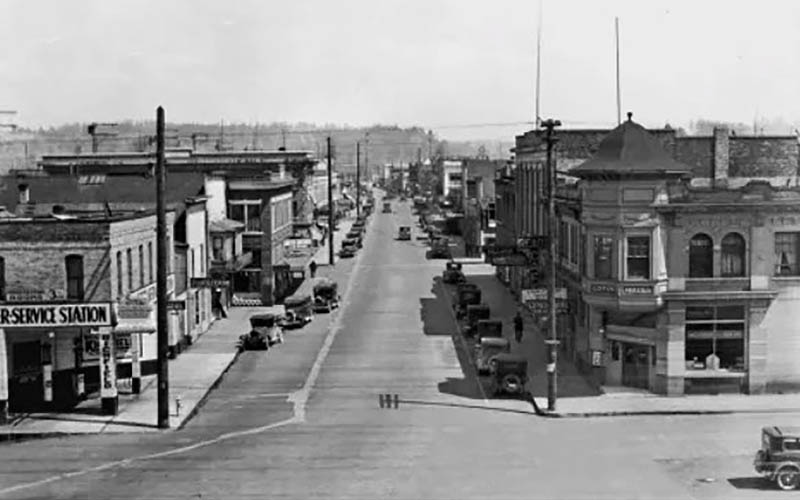
Historical images courtesy of published sources and the White River Valley Museum, Auburn, WA. All rights reserved by respective owners.
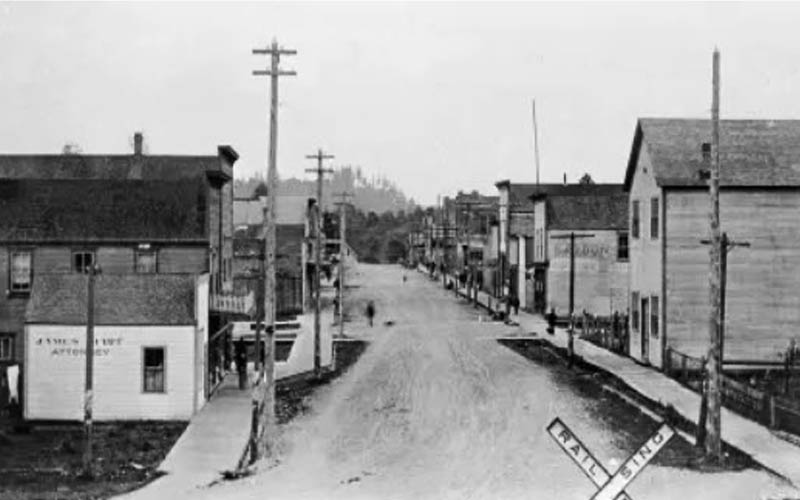
The Northern Pacific Railroad reached Auburn in 1883. By 1891 the town incorporated as "Slaughter", renamed Auburn in 1893 after Oliver Goldsmith's poem. West Main Street developed as the working commercial spine serving constant rail crews, freight workers, and valley farmers. The Skaggs family, whose cash-and-carry model eventually became Safeway, operated in this corridor. Local merchant and photographer Les Rasmus documented the era.
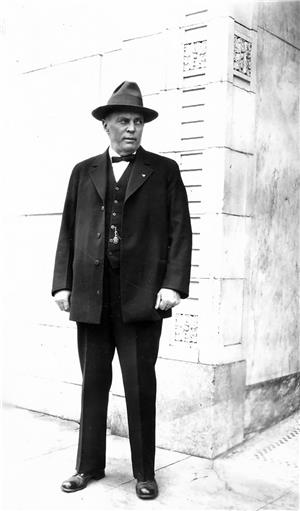
Part of the final wave of downtown wood-frame commercial construction between 1910 and 1913. Original fir floors, high wood plank ceilings, and moldings were installed, all remaining intact today, concealed beneath later improvements. The Nuzum family, prominent Auburn real estate developers, held the block-long parcel before subdivision.
The 1930 Census confirms the building operated as a rooming house for single men employed by the Northern Pacific Railroad. The Depression years were hard on Auburn's merchant community, though rail traffic sustained the block's basic economy.
The building became the central community grocery for East and West Main residents. A 1942 grocery receipt recovered from within the building confirms active WWII-era operation. Japanese immigrant farmers from the surrounding valley, who supplied the store with produce, were forcibly relocated to internment camps in 1942, permanently reshaping Auburn's agricultural economy.
The 1940 Census lists Frederick Jones as head of household at 504 West Main, renting at $20/month, occupation listed as retail salesman. By the 1950 Census he is recorded as owner and proprietor. The block became informally known as the Jones Block, a designation that survives in local historical photographs to this day.
Antique bottles, old tools, and historical photographs were recovered from beneath the building, physical evidence of its continuous use across multiple generations. Newspapers dated 1955 were found within the structure. A 1942 grocery receipt confirms active wartime operation.
The building's longest single-use chapter. The large red-lettered sign became a neighborhood landmark along West Main for generations. Continuous commercial operation through March 2020 — closed during the Covid-19 shutdown — confirms sustained utility as a working storefront across Auburn's most significant commercial transitions.
The building is offered as-is. Primary value is the parcel, the corridor position, and the retained garage. For a buyer with preservation intent, the physical and archival record supports National Register candidacy and access to federal Historic Tax Credits.
This building's documented provenance, census-verified ownership chain, physical artifact recovery, 113 years of continuous use, and 1911 construction within a documented commercial wave, positions it as a viable National Register of Historic Places candidate. Listing unlocks the federal 20% Historic Tax Credit on qualified rehabilitation expenditures, state preservation grants, and potential marketing value for hospitality, residential, or professional conversion. The White River Valley Museum in Auburn holds archival materials relevant to any nomination process.
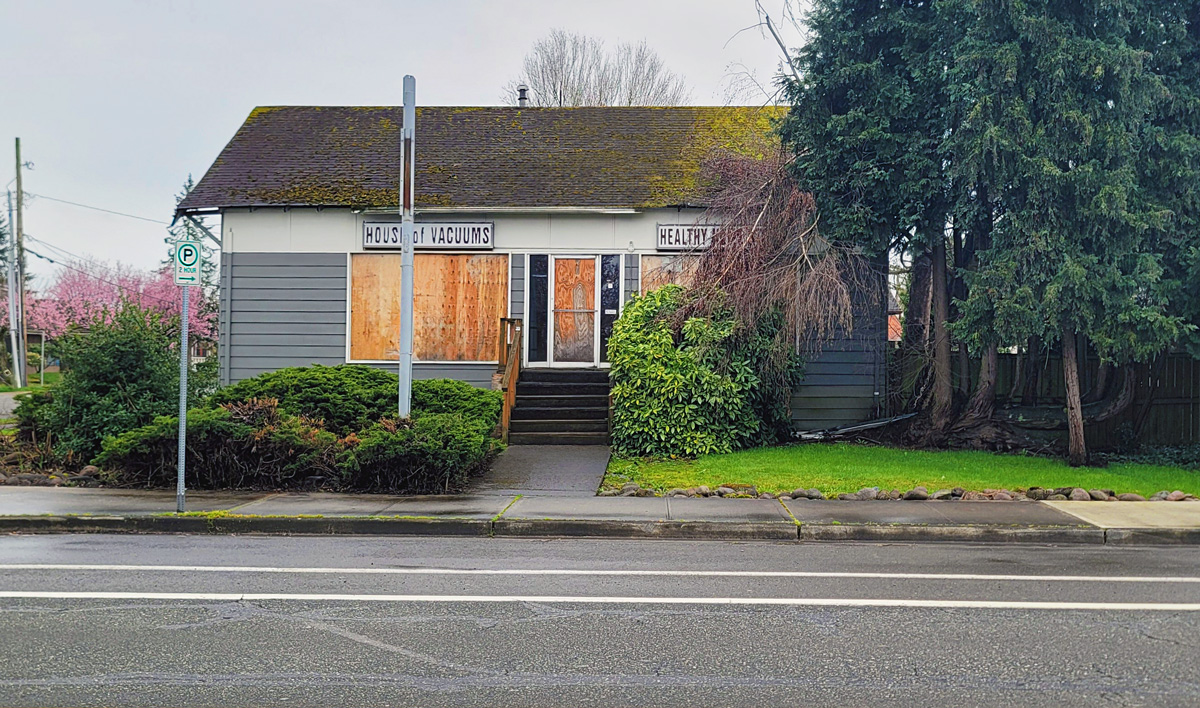
504 West Main Street · Auburn, WA · House of Vacuums Signage · SR-167 Corridor Visible